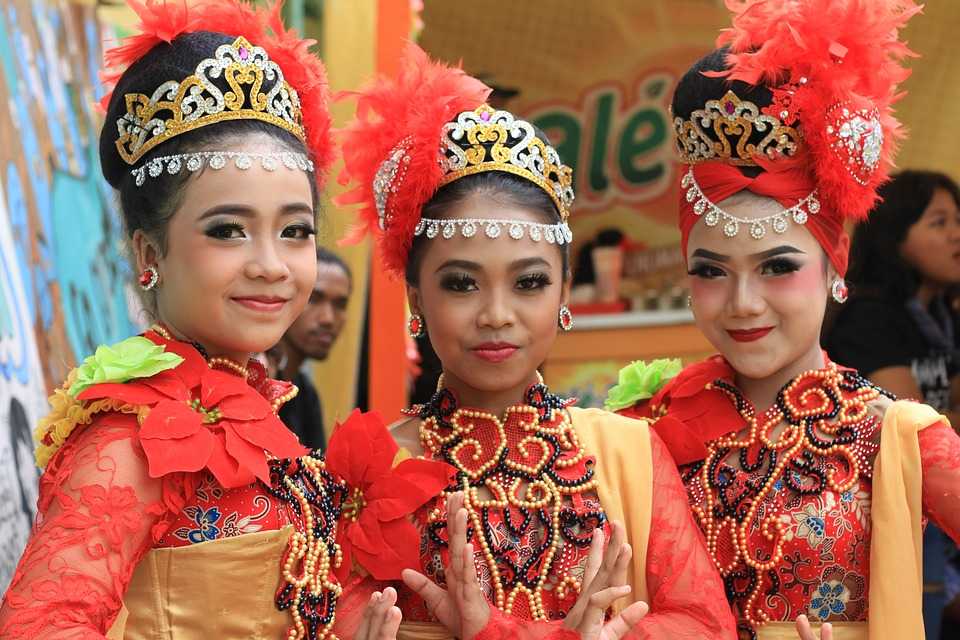
1. Merak, West Java - The Peacock Dance

Stemmed from the soil of Pasundan, Merak is a beautiful form of dance in Indonesia. It is a greeting act at the beginning of wedding ceremonies. The dance embodies the attraction of female peacocks by the male.
For this dance, women dress in an intricate peacock designed costumes. This dance form symbolizes the movements of the magnificent bird. It is full of grace and finesse. The women dance effortlessly to melodious tunes and enchant the audience with their poise.
2. Saman, Aceh - The Dance of a Thousand Hands
Saman comes from Gayo Lues in Aceh and is performed by the Gayo people. Dancers kneel shoulder to shoulder in a tight row and move only their hands, arms, head and upper body, clapping their chests and thighs and singing the rhythm themselves. There are no instruments at all. The tempo builds until the line moves as a single body, and a single dancer out of step is immediately visible. UNESCO added Saman to its List of Intangible Cultural Heritage in Need of Urgent Safeguarding in 2011.
3. Kecak, Bali - The Ramayana Monkey Chant
Kecak is the one most visitors see. Dozens of bare chested men sit in concentric circles around a lamp and chant "cak, cak, cak" in interlocking rhythms, standing in for a gamelan orchestra, while dancers in the centre act out episodes from the Ramayana. It was shaped in the 1930s from the older sanghyang trance ritual and is now performed nightly at Uluwatu Temple, where the sunset over the cliff is half the draw.
4. Legong, Bali - The Refined Court Dance
Legong is the most technically demanding of the Balinese dances and was historically performed for royal courts by girls who began training before their teens. Everything happens in the detail: flicked fingers, darting eyes, a shiver of the shoulders, all locked to the gamelan. Dancers wear tightly bound gold brocade and frangipani crowns. Look for it at Ubud Palace, where several troupes perform on a rotating weekly schedule.
5. Pendet, Bali - The Welcome Dance
Pendet began as a temple offering dance, performed by women carrying bowls of flower petals to greet the gods. It has since become the dance that opens ceremonies and welcomes guests, with the dancers scattering petals over the audience at the close. The movements are gentler and easier to follow than Legong, which is why it is often the first Balinese dance a visitor sees.
6. Jaipong, West Java - The Modern Folk Dance
Jaipong is the youngest dance on this list. Choreographer Gugum Gumbira built it in the 1970s out of older Sundanese forms, chiefly ketuk tilu and the martial art pencak silat, at a time when Western pop was crowding out regional music. It is faster, more hip driven and more openly flirtatious than the court dances, and it was controversial for exactly that reason. Today it is a staple of Sundanese weddings and West Javanese celebrations.
7. Reog Ponorogo, East Java - The Lion Mask Dance
Reog centres on the Singo Barong, a huge mask combining a tiger or leopard head with a fan of real peacock feathers. It weighs roughly 30 to 40 kg, and the dancer carries the whole thing gripped in his teeth, sometimes with a boy riding on top, which pushes the load towards 100 kg. The dance retells a Ponorogo legend of a king, a princess and a rival army. UNESCO inscribed Reog Ponorogo on its urgent safeguarding list in December 2024.
8. Cakalele, Ternate - The War Dance
Celebrating the valor of the Malaku stalwarts, Cakalele is a dance form standing apart from the others. It is meant to enrage the spirit of war among the people and is performed by male dancers with the support of a few female performers. Cakalele embodies the customs of the Malaku tribe, representing their bravery.
Originally a war dance, it is now used to attract tourists and promote the tourism of Indonesia. They are staged as acts of entertainment or traditional celebrations. It is also used for the appreciation of the Malaku ancestors. This is one of the dances of Indonesia that has worldwide recognition.
9. Roro Anteng and Joko Seger Dance, Tengger - A Tribute to the Legends
Indonesia is rich in traditional and legendary dance forms, Roro Anteng and Joko Seger being one of them. It celebrates the tales of the legends Roro Ateng and Joko Seger and the origins of Yadnya Kasada.
This dance form is very similar to Balinese dance forms which involve slow-paced dance moves with great refinement. The dance immortalizes two legends, thus it is practised keeping in mind the age-old traditions.
A lot of care is ensured while performance as superstition says that slight refashioning could result in enraging God Hyang Widhi. The costumes are also blessed by the local shaman before the performance. About thirty to thirty-five dancers dance to melodious chantings. The dance form always ends up being a masterpiece act.
Indonesian Dance Festival
Almost every year, Indonesia holds an Indonesian Dance festival where not just in-house dancers but dancers from different countries of the world like Mexico, France, India, Germany, Australia, Singapore, and South Korea get together and show active participation with great enthusiasm. The 14th Indonesian Dance Festival was held on November 3rd, 2018. The next one is soon to arrive. So you must seize the opportunity and experience the most magnificent dances of Indonesia and around the world.
These dance forms are highly impressive. With graceful movements, varied dance techniques, tales behind the dance forms, costumes, masks and expressions, you are sure to get attracted their dances. Indonesia is housed with some of the most charming and ravishing dance forms. One can surely take home some inspiration from these dances of Indonesia. Each dance act is an unforgettable experience and it will leave a lasting impression in your mind.
Planning a longer trip? Browse our Indonesia tour packages.
 )